
Education
Luovi offers vocational special needs education and training (VET) on upper secondary level for young people:
- vocational qualifications in six fields of study
- Preparatory education for programmes leading to an upper secondary qualification (TUVA)
- Preparatory education and training for work and independent living (TELMA)
Luovi offers vocational education in Finnish. Learning takes place in collaboration with working life and in real working places. Every student has a personal study plan, which is monitored in a multi professional team.
As special needs VET provider we offer education for students who have a reason for special education, guidance and consultation in studies or employment. Reasons may include for example social difficulties, health issues or learning difficulties.
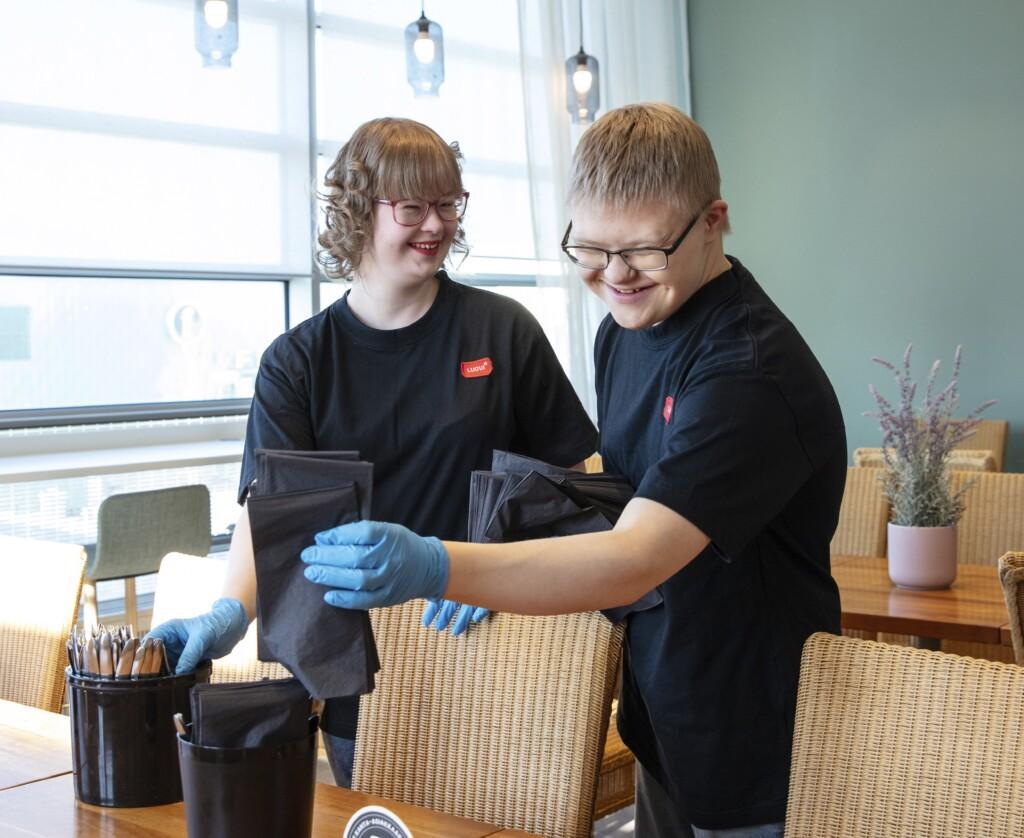
Preparatory education for programmes leading to an upper secondary qualification (TUVA) and Preparatory education and training for work and independent living (TELMA).

VET programmes. Luovi offers vocational qualifications in six fields of study.
Preparatory education TUVA and TELMA
The objectives are based on each student’s individual needs and capabilities. The scope of the education is 60 competence points.
Each student’s local community, family and other interest groups in their domicile will be utilised as the student’s resource potential. Different types of work activities are also arranged by students’ municipalities of residence.
Preparatory education for programmes leading to an upper secondary qualification (TUVA)
The purpose of the training is to support the knowledge and skills required for completing upper secondary vocational qualifications. Objectives include helping students to develop their life skills and to pursue functional independence.
Study modules include native language and communications, foreign languages, mathematics, basic functional capabilities and labour-market studies.
The content of the training scheme may be targeted at a certain field of education (groups specialising in office services and information technology, for example), or it may involve teaching that prepares students for upper secondary vocational education and training.
Preparatory education and training for work and independent living (TELMA)
This training is intended for students who are capable of studying parts of study modules in accordance with their own potential. The objectives specified for upper secondary vocational qualifications are, however, too demanding for students engaged in TELMA.
The aim of the training is to enable students to function as independently as possible in working life and to assume responsibility for looking after themselves. Another intention is to ensure that students can seek non-contractual employment or become employed at a sheltered workshop, for instance. In addition to vocational subjects, the training includes studies in interaction and life skills, as well as in social capabilities.
Students may specialise in woodwork, textiles work or food management, for instance, or they may choose courses from the following fields of education: catering, property maintenance, cleaning, metalwork, office and courier work, and warehouse work.
The training may also take the form of multiform studies, in which case students complete study modules at the training centre and employment periods in their home municipalities. The training may take the form of further vocational studies or it may be completed in preparation for vocational education and training or employment.
VET programmes
At Luovi Vocational College, students study towards an occupation in small groups, with emphasis on practical aspects. All studies include personal instruction.
Luovi offers upper secondary vocational education and training in six fields including 16 different vocational qualifications.
The scope of upper secondary vocational qualifications is 180 competence points, consisting of
- core subjects
- vocational studies
- free-choice studies.
Vocational studies include at least 30 competence points of on-the-job learning.
Learning Environments
Acquiring skills involves learning, studying, and participating in teaching in various learning environments. It can take place through independent study or work or in groups.
Learning Environments at Luovi Vocational College
- classrooms, workshops and other facilities of Luovi
- work places in Finland or abroad
- digital learning platforms and environments
- other forms of in-person instruction e.g. collaborative environments and community-based learning in projects
Digital learning opportunities – time and place, in-person and remote
Digital learning at Luovi is flexible in terms of time and place. Learning can take place in-person or remotely, or students can combine both. In remote learning, students study from home or at work and connect to the school online.
Learning can also be synchronous or asynchronous: in synchronous learning, all students participate at the same time either in-person or online, while in asynchronous learning, students can choose when to study. Students and teachers discuss the different learning options, considering the realistic possibilities for organizing teaching in various ways.
Digital Learning Platforms
The main digital learning platform used by students is Microsoft Teams. It also enables the use of Class-Teams, where students can complete assignments flexibly. In addition, Workseed—a work-based digital learning environment—and Google Classroom are in use. There are also some sector-specific platforms in use, such as Prodiags for automotive studies and eKampus for culinary studies.
Within these digital learning environments, a wide range of digital tools can be utilized in addition to Microsoft services, such as Padlet, Thinglink, Wordwall, and various communication support applications.
Artificial intelligence is integrated into several of these services. Simulation environments are also used, for example, a driving simulator for driver training, a welding simulator for machining studies, and virtual learning content in various fields.
On-the-job learning
Vocational studies include on-the-job learning. At Luovi, students acquire skills in real work tasks at workplaces through a training contract, an apprenticeship contract, or a flexible combination of the two. In both cases we ensure that the workplace has tasks that correspond to the studies, has sufficient activities, necessary production equipment, and competent personnel for supervision.
As part of on-the-job learning, students complete vocational skills demonstrations, which are work situations designed, implemented and assessed together by VET providers and representatives from the working life.
Skills demonstrations enable students to show how well they have achieved the vocational skills required in working life, as specified in curricula. On-the-job learning and skills demonstrations are primarily completed in authentic working environments.
Support services for students
As a special needs VET provider Luovi offers comprehensive support services. Students receive guidance and counseling for their professional growth and well-being throughout their learning pathways.
Luovi’s staff is there for the students from the time of applying all the way through their studies. Counseling is provided to everyone to support placement on the labour market or in further studies.
Luovi co-operates closely with student’s personal networks: such as carers and other service providers.